




Sekoia Blogs
Peeking at Reaper’s surveillance operations
In this blogpost you will find the results of a survey conducted by our analysts on two Command and Control servers (C2s) of the North Korea-nexus intrusion set Reaper (aka APT37). This investigation led to the uncovering of several phishing webpages

How to improve data collection from endpoints? (Tutorial 2023)
The SEKOIA.IO Agent is out of Beta. To install it, simply follow the different configuration steps that we detail in this blog post.

Stealc: A copycat of Vidar and Raccoon infostealers gaining in popularity - Part 2
This blog post is a technical analysis of Stealc infostealer, detailing different characteristics of the malware, including anti analysis, strings de-obfuscation and C2 communication techniques.
One year after: The cyber implications of the Russo-Ukrainian war
One year after the start of Russo-Ukrainian War, our analysts share through their analysis pertaining to the cyber picture.

Stealc: a copycat of Vidar and Raccoon infostealers gaining in popularity - Part 1
This blogpost aims at presenting the activities of the Stealc’s alleged developer, a technical analysis of the malware and its C2 communications, and how to track it.

Sekoia Ransomware Threat Landscape (second-half 2022)
This blog post aims at analysing and highlighting trends within the ransomware ecosystem in the second half of 2022

Command & Control infrastructures tracked by Sekoia in 2022
Throughout 2022, Sekoia's Threat & Detection Research (TDR) team continued to proactively track and monitor the Command & Control (C2) infrastructures set up and used by cybercriminal or state sponsored intrusion sets to carry out malicious cyber

Raspberry Robin's botnet second life
As many botnets and worms, Sekoia analysts demonstrate through this article that Raspberry Robin can be repurposed by other threat actors to deploy their own implants.

Unveiling of a large resilient infrastructure distributing information stealers
This blogpost aims at presenting the current infection chain, payloads and the whole infrastructure used to distribute infostealers
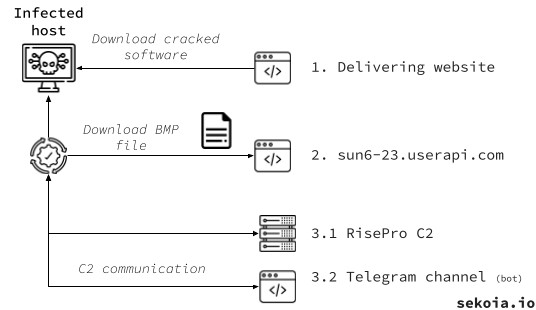
New RisePro Stealer distributed by the prominent PrivateLoader
This article aims at presenting Sekoia's RisePro information stealer analysis.

The DPRK delicate sound of cyber
Discover malicious activities associated to the DPRK-nexus Intrusion Sets (Kimsuky and Lazarus group) reported in open sources in 2022.

How to use Sekoia indicators in Microsoft Sentinel ?
Sekoia.io indicators can be integrated into Microsoft Sentinel One. In this blogpost, discover how to take advantage of this integration.

Calisto shows interest in entities involved in Ukraine war support
Calisto (aka Callisto, COLDRIVER) is suspected to be a Russian-nexus intrusion set active since at least April 2017. Although it was not publicly attributed to any Russian intelligence service, past Calisto operations showed objectives and victimology that were closely aligned with Russian strategic interests.

Lucky Mouse: Incident Response to Detection Engineering
This blogpost discusses how the Tactics, Techniques and Procedures (TTPs) used by the APT27 (Lucky Mouse) intrusion set in the last incident reported by Intrinsec, a Sekoia Managed Security Service Provider (MSSP) partner, are detected using SEKOI

Aurora: A rising stealer flying under the radar
Sekoia analysed Aurora in depth and share the results of our investigation in this article.

BlueFox Stealer: A newcomer designed for traffers teams
In September 2022 during routine Dark Web monitoring we identified BlueFox Stealer v2, a newly-advertized information stealer sold as MaaS.

XDR detection engineering at scale: Crafting detection rules for SecOps efficiency
In this blog post we present Sekoia’s process to create detection rules, which first requires explaining our detection workflow as well as understanding Sekoia XDR history and specificities.

PrivateLoader: The loader of the prevalent ruzki PPI service
Sekoia analysts tracked PrivateLoader’s network infrastructure for several months and recently conducted an in-depth analysis of the malware. In parallel, we also monitored activities related to the ruzki PPI malware service.

Traffers: A deep dive into the information stealer ecosystem
Traffers are responsible for redirecting user traffic to malicious content (malware, fraud, phishing, scam) exploited by other threat actors.
LuckyMouse uses a backdoored Electron app to target MacOS
LuckyMouse uses a backdoored Electron app to target MacOS. This is the first time that Sekoia observed LuckyMouse targeting MacOS.

Sekoia mid-2022 ransomware threat landscape
Sekoia presents its Ransomware threat landscape for the first semester of 2022, with the following key points...
Threat Detection & Research team
Sekoia Threat Detection & Research team, commonly known as the TDR team, is the driving force behind the Sekoia SOC platform, delivering exclusive threat intelligence.
