
Executive Summary
- In 2024 multiple worldwide elections will be held with 54% of the world population called to vote. Electoral results can potentially influence the geopolitical landscape, making elections a prime target for cyber offensive operations aimed to influence the outcome.
- Sekoia.io conducted a general assessment of past elections impacted by cyber attacks, identifying four categories of operations : hack-and-leak operations following a cyber intrusion; information and cyber influence campaigns; attempted cyber disruption of the voting process; and lucrative campaigns impacting the electoral process.
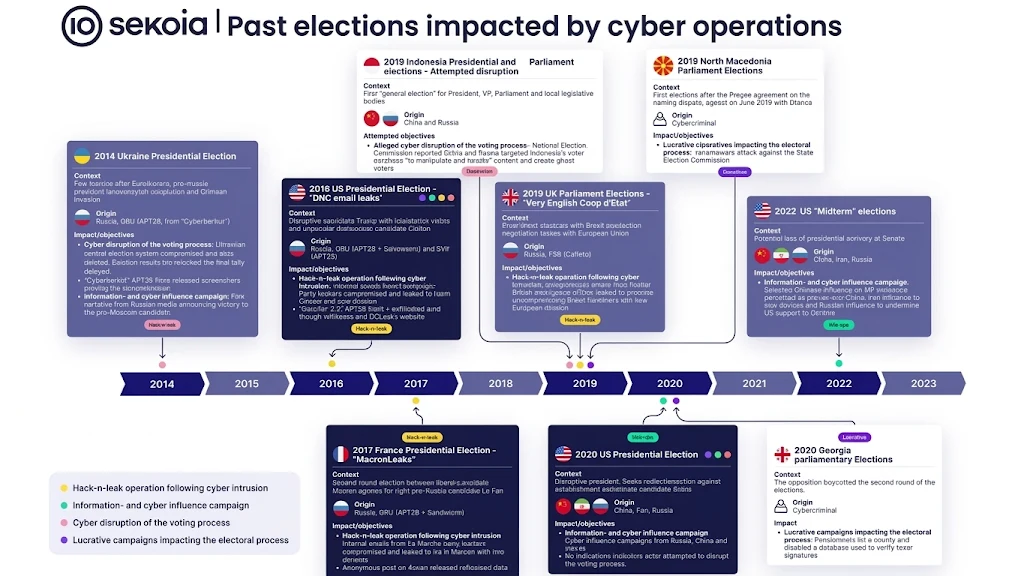
- "Hack-and-leak operations" involve planning a long-term cyber intrusion looking for compromising documents published to fuel narrative undermining a candidate. The most critical exemples are the DCleaks and MacronLeaks operations, conducted by Russian military intelligence against US and French presidential elections in 2016 and 2017.
- "Information and cyber influence campaigns" are nowadays more likely to be used than hack-and-leak against 2024 elections, as they do not require sophisticated cyber intrusion yet are still efficient. "Cyber disruption of the voting process" may sound the most concerning threat, but successful or even attempted operations are not common.
- Few elections were also impacted by lucrative cybercrime campaigns having consequences on the electoral processes yet without the specific intent to alter the outcome.
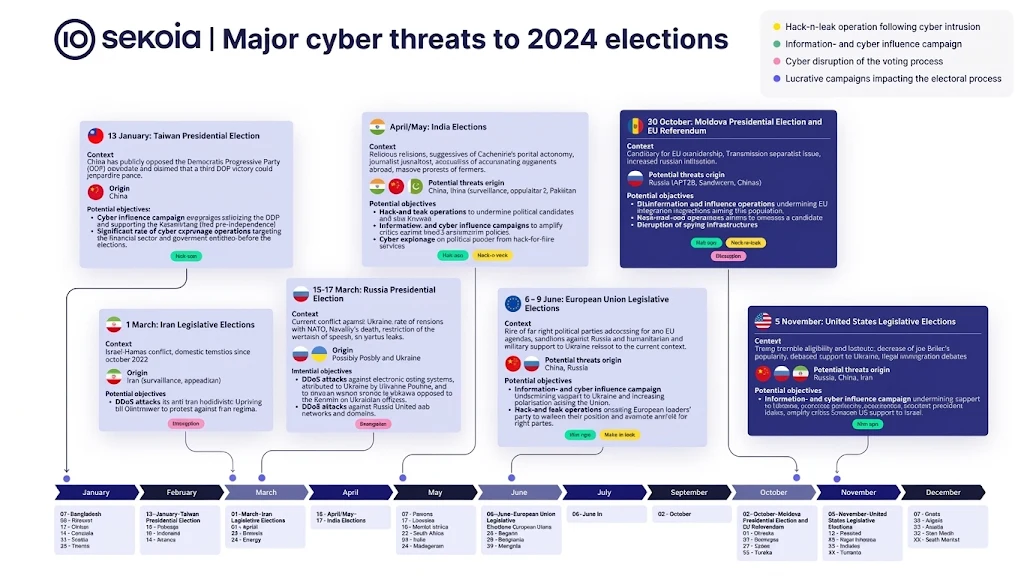
- For the remaining upcoming 2024 elections, Sekoia.io assess four of them are likely to be targeted by cyber operations aiming to influence the geopolitical landscape: the US presidential elections, the European Parliament elections, the Moldova presidential election with a referendum on joining the EU, and the India parliamentary elections.
- Those elections face primarily information and cyber influence campaigns, to a lesser extent hack-and-leak operations; for Moldova, cyber disruption of the voting process may be attempted, as the potential impact of such campaigns could be politically significant.
Introduction
2024 marks a pivotal moment in global politics as an unusual number of elections have and will take place across various nations, encompassing approximately 54% of the world's population. Elections serve as keystone events in democratic societies, signifying not only the will of the people but also stability and continuity in governance. Beyond shaping domestic policies, the outcomes of these elections hold significant implications for long-term foreign policy directions.
Given today's interconnected world, electoral results can potentially influence the geopolitical landscape, prompting both allies and adversaries to assess and adapt their strategies accordingly. This makes elections a prime target for external actors, who may seek to strengthen friendly regimes, undermine rivals, or manipulate the trajectory of foreign relations for their own strategic interests.
Sekoia TDR analysts conducted an in-depth analysis of cyber threats on elections based on past targeted elections, identifying various types of cyber operations, and propose an assessment of threats regarding the major elections that will occur in 2024.
Cut-off date for this paper is 12 April 2024.
Read the full version of this article in PDF
The full version of this article is available in PDF format. Feel free to read it and share it with your network.