

Best cybersecurity platforms: Where should you start?
The phrase “best cybersecurity platforms” covers several different jobs.
A platform may focus on network security, cloud security, endpoint protection, identity management, vulnerability management or security operations. Some products specialize in one layer. Others bring several layers together so security teams can detect, investigate and respond from the same environment.
That makes comparison useful, but it also makes a simple ranking difficult. The right choice depends on what your team needs to improve first.
Are you building a security operations center from the ground up? Are you looking to replace a legacy SIEM? Do you need stronger endpoint protection? Are your analysts spending too much time moving between tools? Or are you looking for a cloud based platform that works with the systems you already use?
This guide looks at several leading cybersecurity platforms and the use cases they are best suited to support.
What makes a cybersecurity platform a good fit?
Before comparing individual security solutions, it helps to agree on what a good platform should do.
It should match your security model
A global enterprise, a mid-sized business and an MSSP may all search for the best cybersecurity platform. Their requirements will be different.
An enterprise may prioritize governance, compliance, identity and broad coverage across multiple business units. A smaller team may value ease of deployment and a clear path to operational maturity. An MSSP may need multi-tenancy, predictable economics and the ability to manage multiple customer environments from one platform.
The best platform is the one that fits the way your security team works.
It should connect the signals that matter
Cyber threats rarely stay inside one part of an environment. A suspicious identity event may be connected to activity on an endpoint, a cloud workload or an internal network.
A modern cybersecurity solution should bring relevant signals together so analysts can see the wider context. That may include logs, endpoint activity, cloud data, identity information, threat intelligence and vulnerability context.
It should support threat detection and response
Detection is only one part of security operations. A platform also needs to help analysts understand what happened, decide what matters and take the right action.
This is where the difference between a collection of security tools and a wider cybersecurity platform becomes clear. A platform should help your team move from signal to investigation, and from investigation to response.
It should work with your existing environment
Most organizations already have security controls in place. They may use a firewall from one vendor, endpoint protection from another and cloud services from several providers.
A good platform should make those investments more useful. Open integrations, flexible deployment and support for existing tools can help security teams improve coverage without rebuilding everything at once.
It should be understandable to the people using it
Security software can be technically advanced and still be difficult to operate.
Security analysts need clear evidence, useful context and a straightforward way to investigate alerts. Security leaders need to understand the platform’s role, scope and value. A platform that makes its decisions easier to review can also make security operations easier to improve.
Cyber security starts with the operating model
Technology matters, but the operating model matters just as much.
A business with a dedicated SOC may need a platform that helps analysts manage more investigations. An MSSP may need a platform designed for multiple customers and communities. A regulated organization may require sovereign hosting, on-premises deployment or an air-gapped environment.
This is why two organizations can evaluate the same cybersecurity software and reach different conclusions.
The most useful question is not “Which platform is number one?” It is “Which platform is best for the way we need to operate?”
Network security
Network security remains a core part of any cybersecurity strategy. Firewalls, secure access, segmentation and network monitoring help organizations control how systems communicate and identify unusual activity.
However, network security is only one part of a wider defense model. Security teams also need to connect network events with endpoint, identity, cloud and threat intelligence data.
A cybersecurity platform can provide that wider operating layer. It can help analysts understand whether a network event is isolated or connected to activity elsewhere in the environment.
For teams comparing platforms, look at how each vendor handles data from network security tools. Ask whether analysts can investigate those events alongside endpoint, cloud and identity signals.
Cloud security
Cloud environments create flexibility, but they also increase the number of services, identities and configurations that security teams need to understand.
Cloud security includes several related jobs:
- Monitoring cloud infrastructure and services.
- Detecting suspicious identity activity.
- Finding exposed or misconfigured resources.
- Protecting sensitive data.
- Investigating activity across hybrid cloud and multi-cloud environments.
- Supporting compliance requirements.
Some products focus specifically on cloud posture management or workload protection. Others bring cloud data into a wider security operations platform.
The right choice depends on whether your priority is cloud configuration, cloud workload protection, security operations or a combination of these areas.
A useful platform should help your analysts connect cloud events with the wider environment. This gives the security team a better view of the incident and helps them decide what action to take.
Cybersecurity solutions for different security teams
A practical comparison looks at the job each platform does best.
The right platform may also be part of a wider architecture. Many security teams combine a specialist endpoint or network product with a platform that brings signals together for detection and response.
Sekoia: Best for autonomous defensive intelligence
Sekoia is a strong fit for organizations that want detection, investigation and response to work as one connected process.
The Sekoia autonomous defensive intelligence platform brings together security information and event management, security orchestration and automation, threat intelligence and investigation capabilities. Its positioning is built around helping security teams act from clarity, with artificial intelligence supporting analysts during triage and investigation.
The autonomous SOC platform includes:
- Sekoia Reveal, which adds context about assets, identities, exposure and vulnerabilities.
- Sekoia Intelligence, which provides threat intelligence and attacker knowledge.
- Sekoia Defend, which supports detection, triage, investigation, case management and response.
- Sekoia Elevate, which adds AI agents that investigate, correlate, explain and recommend action.
- Sekoia Digital Risk, which monitors for leaked credentials, live sessions and brand mentions.
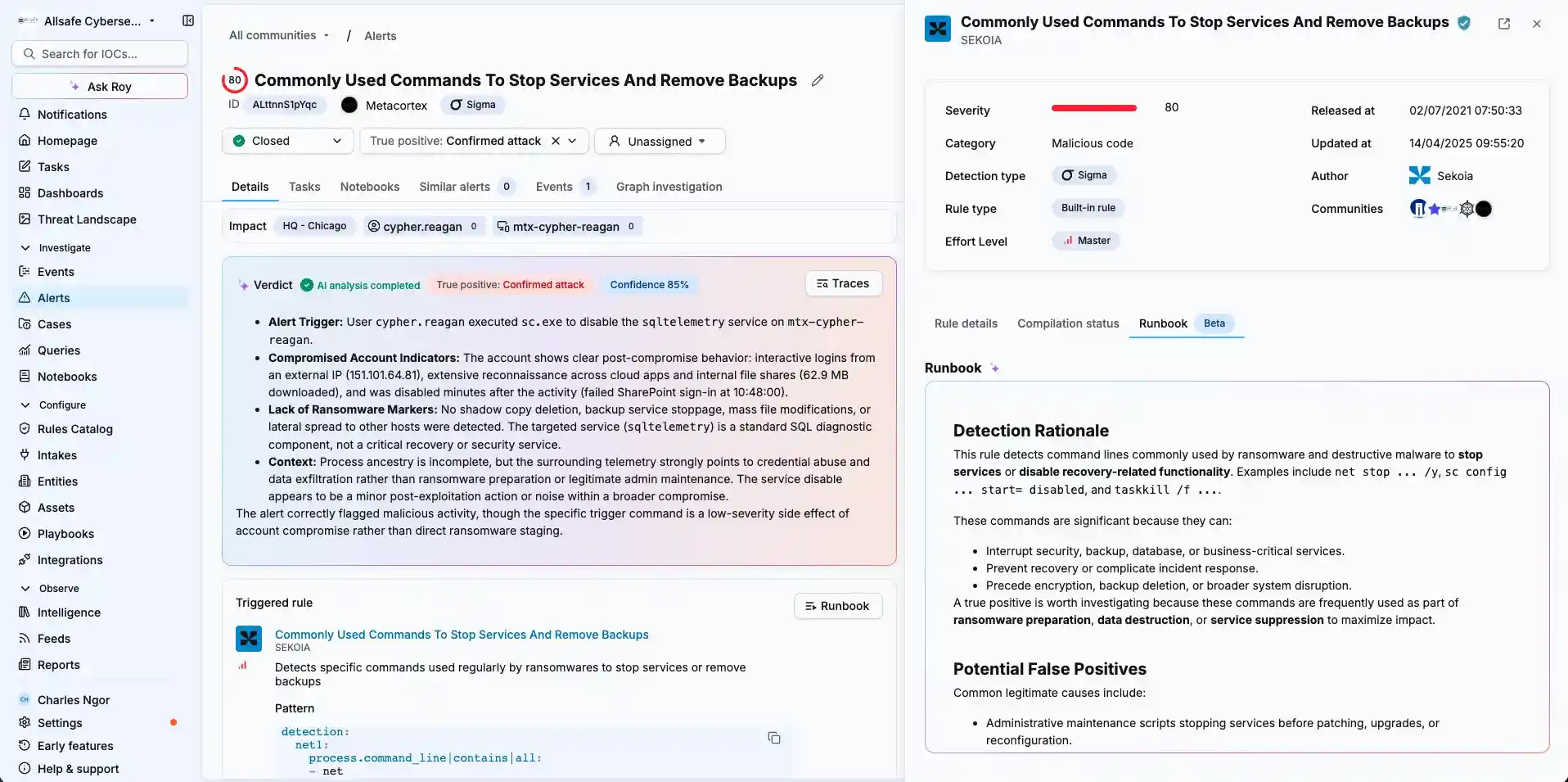
Sekoia Elevate is designed to investigate alerts from inside the platform. The agents can assess relevance, gather evidence, use threat intelligence and provide a verdict with confidence, findings and reasoning. Analysts can review the queries behind the findings, override a verdict and inspect the action trace.
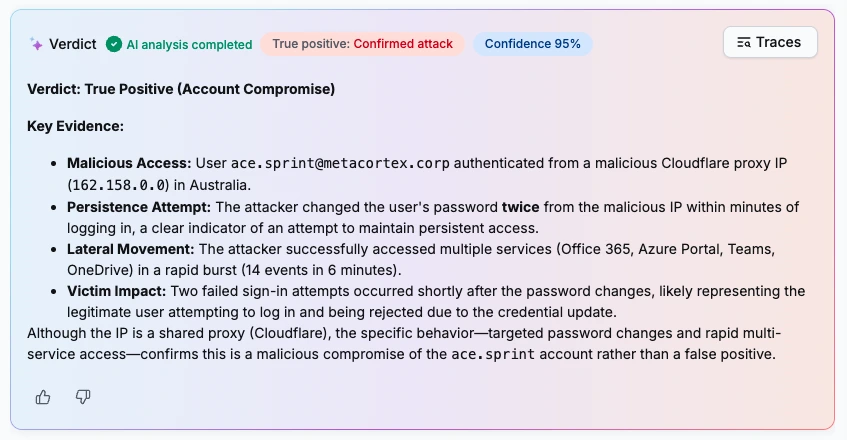
This makes Sekoia a strong option for security teams that want AI to support analysts while keeping the investigation understandable and reviewable.
Sekoia also suits MSSPs that need a multi-tenant operating model, with more than 300 native integrations out of the box.
Sekoia is particularly relevant when the priorities are:
- A unified platform for detection and response.
- Native threat intelligence within the investigation workflow.
- Sovereign deployment options.
- A platform that works across different environments.
- Multi-tenant operations for MSSPs.
- AI-assisted investigation with clear evidence and reasoning.
There is also the possibility to use Sekoia Self-Hosted.
Palo Alto Networks: Best for enterprise security consolidation
Palo Alto Networks is a strong choice for large enterprises that want broad security coverage from an established vendor.
Cortex XSIAM brings security operations, endpoint protection, response automation and attack surface capabilities into a wider consolidation strategy. It is especially relevant for organizations that already use Palo Alto Networks products and want to build on that existing ecosystem.
Palo Alto Networks may be a good fit when:
- The organization already has a broad Palo Alto Networks deployment.
- Enterprise-wide consolidation is a major priority.
- The security team wants a wide portfolio from one vendor.
- Board-level assurance and established market presence are important.
- The organization has the skills and operating model to manage a broad platform.
Sekoia offers a different direction for organizations that want an open, European and sovereign SOC platform, especially where partner-led delivery, multi-tenancy or deployment flexibility matter. Both approaches can be relevant. The right choice depends on the environment, the buying model and the level of consolidation the organization wants.
CrowdStrike: Best for endpoint-led detection and response
CrowdStrike Falcon is a strong option for organizations that place endpoint protection at the center of their security strategy.
CrowdStrike is known for its endpoint capabilities, threat intelligence, cloud-based delivery and broad market presence. Its platform is a natural fit for teams that want to protect endpoints at scale and extend that protection into wider detection and response workflows.
CrowdStrike may suit organizations that:
- Want a mature endpoint protection platform.
- Need cloud-based operations across a distributed environment.
- Have a strong focus on endpoint detection and response.
- Value an established vendor and broad market adoption.
- Want to build from an endpoint layer into wider security operations.
Sekoia can sit alongside an existing endpoint platform by bringing its signals into a wider SOC workflow. This lets teams use their endpoint investment while connecting it with network, cloud, identity and threat intelligence data. For organizations looking for an independent SOC platform above their endpoint tools, Sekoia offers a way to bring those signals together and investigate them in a wider context.
SentinelOne: Best for automated endpoint protection
SentinelOne Singularity is another strong choice for organizations focused on endpoint security and automated response.
Its strengths include endpoint protection, automated remediation, Storyline correlation, threat hunting and ransomware rollback. Purple AI also supports natural language interaction with security data and helps make hunting more accessible to a wider group of security professionals.
SentinelOne may be a good fit when:
- Endpoint security is the main buying priority.
- The organization wants automated response capabilities.
- Ransomware rollback is an important requirement.
- Security teams want to make threat hunting more accessible.
- The business is looking for a credible alternative to other endpoint-led platforms.
Sekoia starts from a wider SOC platform perspective. It can ingest endpoint signals, then connect them with telemetry, detection rules, threat intelligence, asset context and response workflows. This distinction matters for organizations that want to compare endpoint protection with broader security operations. SentinelOne can be the right choice for endpoint-led protection. Sekoia can be the right choice for teams that want to coordinate detection, investigation and response across their environment.
Splunk: Best for mature SIEM and security analytics
Splunk is a well-established choice for organizations that need mature security analytics, search and compliance reporting.
Its strengths include a broad application ecosystem, powerful search capabilities, a large user community and deep integration across complex data environments. It is a natural fit for teams that have invested in security analytics over time and need a platform capable of working with large volumes of data.
Splunk may suit organizations that:
- Have a mature SIEM program.
- Need deep search and investigation capabilities.
- Rely on established compliance reporting.
- Have specialist internal skills.
- Already operate a significant Splunk environment.
Sekoia offers a more unified SOC platform approach. Alongside data collection and detection, it brings security orchestration, native threat intelligence and AI-assisted investigation into the same operating environment. This can be relevant for teams that want to reduce the distance between detection and verdict. The decision should consider the full operating model, including the skills required to manage the platform, the data sources the team needs to bring in and the investigation process analysts want to follow.
Elastic Security: Best for open and flexible security analytics
Elastic Security is a strong option for engineering-led teams that value flexibility, openness and control over their data.
Its search capabilities, open foundations and detection-as-code approach appeal to organizations that want to build and adapt their own security analytics environment. Elastic can be especially relevant when the wider organization already uses Elastic for observability or application data.
Elastic Security may suit teams that:
- Have strong engineering and detection expertise.
- Want flexible search and data analysis.
- Prefer an open architecture.
- Already use Elastic across the organization.
- Want to build and tune their own detection environment.
Sekoia is designed for teams that want a more complete SOC operating layer. Rather than assembling separate capabilities around a data platform, Sekoia connects detection, investigation, response and threat intelligence in one environment. Elastic is a natural choice for teams that want to build around a flexible data and search foundation. Sekoia is a natural choice for teams that want the platform to carry more of the SOC workflow.
Google SecOps: Best for Google Cloud-aligned operations
Google SecOps is a relevant option for organizations that already rely heavily on Google Cloud and want their security operations to align with that environment.
Google SecOps may suit organizations that:
- Have a strong Google Cloud footprint.
- Want security operations aligned with their cloud provider.
- Need to work with large and distributed data environments.
- Have teams familiar with the Google Cloud ecosystem.
- Prefer a hyperscaler-led platform strategy.
Sekoia offers a different model, with European hosting, sovereign deployment options and an MSSP-first approach. That can be especially relevant for regulated organizations and service providers that need flexibility around data, deployment and customer operations.
Microsoft Sentinel: Best for Microsoft-first environments
Microsoft Sentinel is a natural platform to consider for organizations that already operate deeply within the Microsoft ecosystem.
It can be relevant for teams that want their security operations to work closely with Microsoft identity, endpoint, cloud and productivity services. Microsoft-first organizations may value the continuity of working within an environment they already know.
The key comparison is operating model. Microsoft Sentinel may be the right fit for a team that wants to build its security operations around Microsoft services. Sekoia may be the better fit for teams that want an independent SOC platform, native threat intelligence, flexible deployment and a partner-led model.
Cybersecurity software: How to make the final choice
Once you have a shortlist, compare the platforms against your own requirements. The best AI security platforms should tick most of the boxes.
Start with the security outcomes
Define what the platform needs to improve.
That could include:
- Better visibility across cloud environments.
- Faster investigation of potential threats and the threat landscape.
- Stronger endpoint protection.
- More consistent incident response.
- Better use of threat intelligence.
- Lower manual workload for security analysts.
- Simpler compliance reporting.
- More scalable operations for an MSSP.
A clear outcome makes it easier to compare products that come from different categories.
Map your existing tools
List the security tools already in place. Include endpoint, network, cloud, identity, vulnerability management, data security and threat intelligence products.
Then ask how each platform will use those investments. Will the platform replace them, connect to them or sit above them as a security operations layer?
Understand the data model
Ask what the platform needs to collect, where it stores the data and how analysts access it during an investigation.
The details matter in hybrid cloud and multi-cloud environments. They also matter for regulated organizations with specific requirements around data location, access and control.
Test the investigation experience
A polished demonstration can show what a platform looks like. A real evaluation should show how it handles your alerts and your data.
Ask your security analysts to test:
- How quickly they can understand an alert.
- How much context the platform provides.
- Whether evidence is easy to review.
- How threat intelligence appears in the investigation.
- How analysts move from investigation to response.
- Whether the platform supports their existing workflows.
Consider the people who will run it
Every platform needs skilled people. The question is how much work the platform creates around them.
Consider administration, integrations, detection engineering, rule tuning, upgrades, reporting and ongoing support. A platform that fits your team's skills and capacity will be easier to operate over time.
Finding the best cyber security platforms for your team
The best cybersecurity platform is different for every organization. And there are lots of top cyber security platforms out there.
If we had to narrow it down, Palo Alto Networks can be a strong choice for enterprise security consolidation. CrowdStrike and SentinelOne are well suited to endpoint-led protection. Splunk and Elastic Security support different approaches to security analytics and SIEM. Google SecOps and Microsoft Sentinel may fit teams aligned with their respective cloud ecosystems.
Sekoia is designed for organizations that want a unified SOC platform for detection, investigation and response. It brings together security data, native threat intelligence, automation and AI-assisted investigation, with deployment options for organizations that need control over their environment.
The right decision starts with your operating model. Define the security outcomes you need, map the tools you already use and give your analysts a chance to test the investigation experience on real data.
When the platform fits the way your team works, cybersecurity becomes easier to operate and easier to improve.