


Sekoia Blogs

Why multi-tenant SOCs need multi-level agents
One SOC can protect dozens of customers, but every customer works differently. See how multi-level agents give security teams one shared way to investigate alerts, while keeping the local context needed to make the right call.

Beyond Lazarus: Organization of DPRK cyber capabilities
Get the full overview of North Korea's cyber operations, from state institutions and APT clusters to IT workers units, and enablers.

AI SOC agents are only as good as the context they can see
AI SOC agents need more than an alert to investigate threats. See how telemetry, asset data, identities and threat intelligence help explain each verdict.

AI transparency in cybersecurity: How Sekoia handles customer data
Security teams are being asked to trust AI with work that used to belong to experienced analysts. So how can they decide if it’s earned its place there?

What you need to know before putting AI agents in your production SOC
A convincing demo doesn’t prove production readiness. Learn how to test an AI agent before it takes on live SOC investigations.

Every detection needs a next step: Why runbooks solve the investigation problem
A detection can raise the alarm and still leave the analyst with the hardest work. Runbooks put the investigation path beside the alert.

AI SOC integrations: 6 capabilities worth connecting
Explore six AI SOC integrations that bring identity, cloud, vulnerability, phishing, incident and network context into one investigation workflow.

The best of cloud, built safely inside your own perimeter
Discover what self-hosted means for critical sector SOC teams, and how Sekoia can make it happen.
Don’t eat the ChocoPoCs! How vulnerability researchers were repeatedly targeted by trojanised exploits
This article details a campaign targeting vulnerability researchers with "ChocoPoC" malware embedded inside trojanised Python dependencies. Exploiting the pressure to quickly test new vulnerabilities, threat actors distribute a persistent Remote Access Trojan (RAT) that exfiltrates data and harvests credentials from compromised developer environments.

Sold to the Highest Bidder: The Escalation of ADINT from Geolocation Tracking to Intrusion Vector
Discover how private companies repurpose the advertising ecosystem into a global surveillance apparatus.

Sekoia’s new identity: Designed for clarity
Sekoia has partnered with branding agency Bruno to develop a new brand identity and digital experience that reflects who we really are.
Unveiling ErrTraffic: inside a growing ClickFix malware distribution framework
This report details the ErrTraffic threat and its associated ecosystem, highlighting three specific campaigns and their operators' arsenal.

APT28, an evolution of tradecraft
Sekoia TDR looks back at how APT28's arsenal has evolved over two decades, from its signature X-Agent implants to disposable modules, edge-device infrastructure and the first LLM-driven malware.

FSB’s matryoshka #3/3 - Gamaredon’s gifts that keeps unpacking - GammaSteel
Discover part 3 of our FSB Matryoshka investigation. We deep dive into Gamaredon's Gammasteel info-stealer, its data exfiltration TTPs, and indicators.
FSB’s matryoshka #2/3 - Gamaredon’s gifts that keeps unpacking - GammaLoad
In part 2 of our FSB Matryoshka series, we analyze Gamaredon's Gammaload malware variant, dissecting its technical updates and deployment mechanisms.
FSB’s matryoshka #1/3 - Gamaredon’s gifts that keeps unpacking - GammaPhish and GammaWorm
Part 1 of our FSB Matryoshka series. Discover the context behind Gamaredon's cyberespionage campaigns, introducing GammaPhish and GammaWorm operations.

Strategic autonomy in cybersecurity: Where you get to choose
Stop being locked into "black box" ecosystems. Discover how Sekoia’s vendor-agnostic platform ensures data sovereignty, GDPR compliance, and technological independence.

From APT28 to RePythonNET: automating .NET malware analysis
This blogpost covers the tooling and methodology we use at TDR to reverse engineer .NET malware. In our daily work, we encounter a wide range of malware, sophisticated or not, and a significant portion of it is written in .NET.

EvilTokens: an AI-augmented Phishing-as-a-Service for automating BEC fraud - Part 2
Explore how EvilTokens uses AI-driven features to automate and scale BEC workflows. Uncover the PhaaS operations on Telegram.
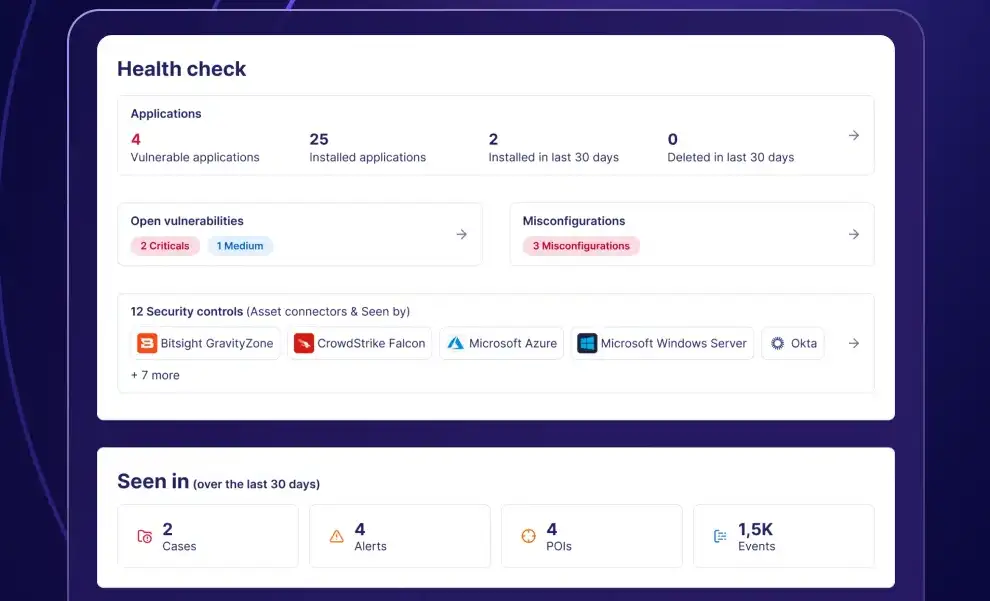
Meet Sekoia Reveal: Turn fragmented asset data into unified SOC context
Security teams do not struggle with a lack of data. They struggle with a lack of context.

New widespread EvilTokens kit: device code phishing as-a-service - Part 1
Uncover the new sophisticated EvilTokens device code phishing as-a-service, with AI-augmented features facilitating BEC fraud.
Threat Detection & Research team
Sekoia Threat Detection & Research team, commonly known as the TDR team, is the driving force behind the Sekoia SOC platform, delivering exclusive threat intelligence.
